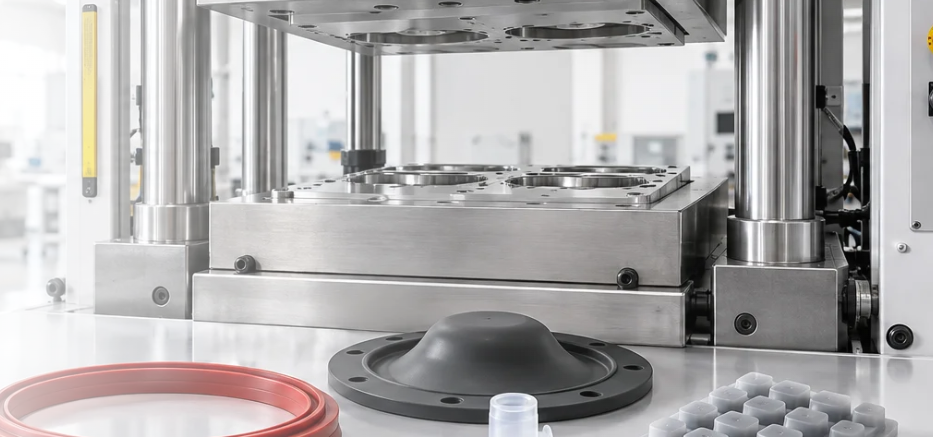
Industrial equipment designers frequently underestimate the financial and mechanical impact of proper mold steel selection when scaling elastomer component production for demanding commercial markets. Building durable tooling for high-viscosity rubber parts requires distinct engineering strategies that contrast sharply with standard thermoplastic injection workflows.
Procurement managers must evaluate tool longevity, cavity layout precision, and long-term maintenance overhead before locking down permanent production budgets. Establishing a rigorous technical framework prevents premature tooling failure and controls financial exposure throughout complex product commercialization cycles, safeguarding long-term market competitiveness.
Selecting Tool Steels for High-Pressure Elastomer Tooling
Mold bases designated for reactive rubber parts experience extreme vertical hydraulic clamping forces and repetitive thermal cycling during continuous industrial vulcanization shifts. Selecting substandard metal alloys leads to rapid parting line degradation, dimensional drift, and excessive flash formation over short manufacturing runs.
Tool steel selection plays an important role in mold durability and structural performance under demanding operating conditions. Materials such as H13 and P20 may be suitable for certain tooling applications, depending on factors such as mold geometry, operating temperature, wear conditions, and expected production volume. Evaluating these requirements helps guide material selection based on the specific needs of each project.
High-grade metal selection protects initial capital investments and guarantees consistent mechanical performance across hundreds of thousands of production cycles.
Operational environments demand that tool steels withstand aggressive chemical exposure from reactive compounding agents without pitting or surface degradation. Integrating high-purity alloy blocks minimizes microscopic surface defects that typically trap elastomer residue during high-frequency demolding sequences.
Tool maintenance technicians rely on these durable material properties to extend active mold lifespans between scheduled refurbishment intervals. Proper alloy matching transforms erratic shop-floor outcomes into predictable, highly repeatable manufacturing results.
Balancing Cavity Layouts to Eliminate Material Drift
Multi-cavity mold layouts require meticulous geometric balancing to ensure uniform pressure distribution across every individual preform position during downward press closure. Inconsistent charge placement causes uneven material flow, resulting in localized density variations and structural voids within finished elastomer parts.
Tooling designers utilize advanced computer-aided simulation software to optimize block arrangements before cutting permanent steel insert blocks. Silicone compression molding programs depend heavily on this upfront geometric optimization to maintain strict dimensional compliance across multi-part production runs.
Balanced cavity networks eliminate scrap rates and reduce secondary trimming labor significantly on the active factory floor.
Controlling material migration pathways prevents the formation of weak weld lines and internal stress concentrations that compromise component resilience under operating loads. Advanced runnerless and modular insert configurations allow manufacturers to scale cavity counts efficiently without redesigning entire base assemblies.
Technical teams verify volumetric charge sizing continuously to maintain absolute consistency across every manufactured batch. Rigorous flow optimization protects proprietary designs and guarantees uniform physical properties throughout commercial distribution channels.
Engineering Thermal Management and Cartridge Heater Placement
Thermal management systems embedded directly within heavy steel tool blocks play a decisive role in controlling rubber curing speeds and vulcanization uniformity. Uneven thermal gradients across upper and lower platen assemblies create soft pockets and un-cured zones that compromise component elasticity under load.
Tooling engineers configure cartridge heater placement meticulously to counteract heat loss occurring around outer tool perimeters during high-speed shifts. Maintaining stable thermal profiles eliminates structural inconsistencies in thick wall sections where material volume increases substantially.
Precise temperature zoning secures optimal cross-linking density throughout intricate geometries without accelerating thermal fatigue in surrounding tool steels.
External insulation blankets and high-conductivity thermal plates further stabilize operating temperatures across fluctuating shop-floor environments. Real-time sensor monitoring allows operators to detect subtle thermal fluctuations before they impact final part cross-linking efficiency.
Proactive thermal maintenance guarantees stable cycle times and repeatable component quality over millions of high-tonnage molding cycles. Mastering thermal dynamics remains vital for achieving absolute structural reliability when executing silicone compression molding operations.
Preserving Shut-Off Lands Against High-Tonnage Wear
Parting line integrity dictates whether a tool successfully resists flash accumulation during prolonged high-pressure vulcanization and cross-linking sequences. Abrasive fillers and high-viscosity rubber compounds subject sharp shut-off lands to severe frictional wear over extended operating periods.
Master toolmakers apply specialized surface nitriding treatments and precision grinding techniques to harden mating perimeters against premature erosion. Maintaining strict edge definition prevents unwanted polymer extrusion and protects cosmetic exterior finishes on delicate components like electronic housing seals.
Routine maintenance protocols ensure that shut-off perimeters remain tightly sealed throughout high-frequency manufacturing campaigns.
Precision land angle adjustments prevent high-tonnage presses from crushing delicate parting surfaces during final locking phases. Implementing robust alignment pillars and guide bushings eliminates lateral shifting that causes uneven edge wear and premature tooling failure.
Systematic wear inspections catch microscopic edge chipping before it expands into costly production delays. Uncompromising attention to parting line geometry ensures long-term operational excellence across global supply chains.
Calculating Long-Term Return on Tooling Investments
Evaluating total project expenses requires analyzing tooling durability alongside per-part manufacturing costs across multi-year commercial product lifecycles. Investing in robust mold construction eliminates frequent tool replacement expenses and prevents unexpected downtime on active manufacturing assembly lines.
HordRT provides comprehensive fabrication guidance designed to maximize structural durability while minimizing upfront capital risks for global clients. Utilizing silicone compression molding techniques through optimized tooling frameworks ensures maximum operational profitability for growing industrial enterprises.
Long-term commercial success relies on proactive engineering decisions made during initial tool design phases to guarantee hardware reliability. Forward-thinking organizations leverage professional manufacturing partnerships to accelerate time-to-market milestones while maintaining uncompromised hardware quality and predictable unit economics.
