Artificial intelligence in healthcare is moving beyond experimental algorithms. Hospitals, medical equipment manufacturers, and healthcare technology companies are increasingly exploring how AI can support diagnosis, monitoring, workflow optimization, and intelligent medical devices.
However, successful healthcare AI requires more than accurate models. Algorithms need reliable computing infrastructure capable of processing medical data securely, efficiently, and close to where clinical decisions are made.
This shift has increased demand for specialized healthcare computing platforms. A Medical Box PC can serve as a bridge between AI software and clinical equipment by providing the processing capability, connectivity, and system stability required for real-world medical environments.
Healthcare AI Is Moving from Research Models to Real-Time Clinical Computing
Early healthcare AI development focused heavily on algorithm accuracy. Researchers trained models using medical images, patient information, and clinical datasets to identify patterns that could support healthcare professionals.
The challenge begins when these algorithms leave research environments and enter hospitals or medical facilities. Clinical systems must process data quickly while integrating with existing equipment and workflows.
Medical imaging is a clear example. AI-assisted analysis of ultrasound, CT, X-ray, or other imaging data requires computing resources capable of handling large datasets without creating unnecessary delays.
The transition from algorithm development to clinical deployment requires hardware designed specifically for healthcare scenarios. Computing systems must support continuous operation, multiple device connections, and reliable data processing.
Clinical AI Needs Computing Power Closer to Medical Data
Traditional healthcare systems often rely on centralized servers or cloud platforms for data processing. While cloud computing provides scalability, some clinical applications require faster responses and more direct control over sensitive information.
Edge computing addresses this challenge by bringing processing capabilities closer to medical devices and healthcare professionals.
For example, an AI-enabled diagnostic workstation may need to analyze image data immediately after acquisition. A patient monitoring system may require real-time processing to identify changes in vital information.
Local computing reduces dependence on external networks and allows medical equipment to perform intelligent functions directly at the point of use.
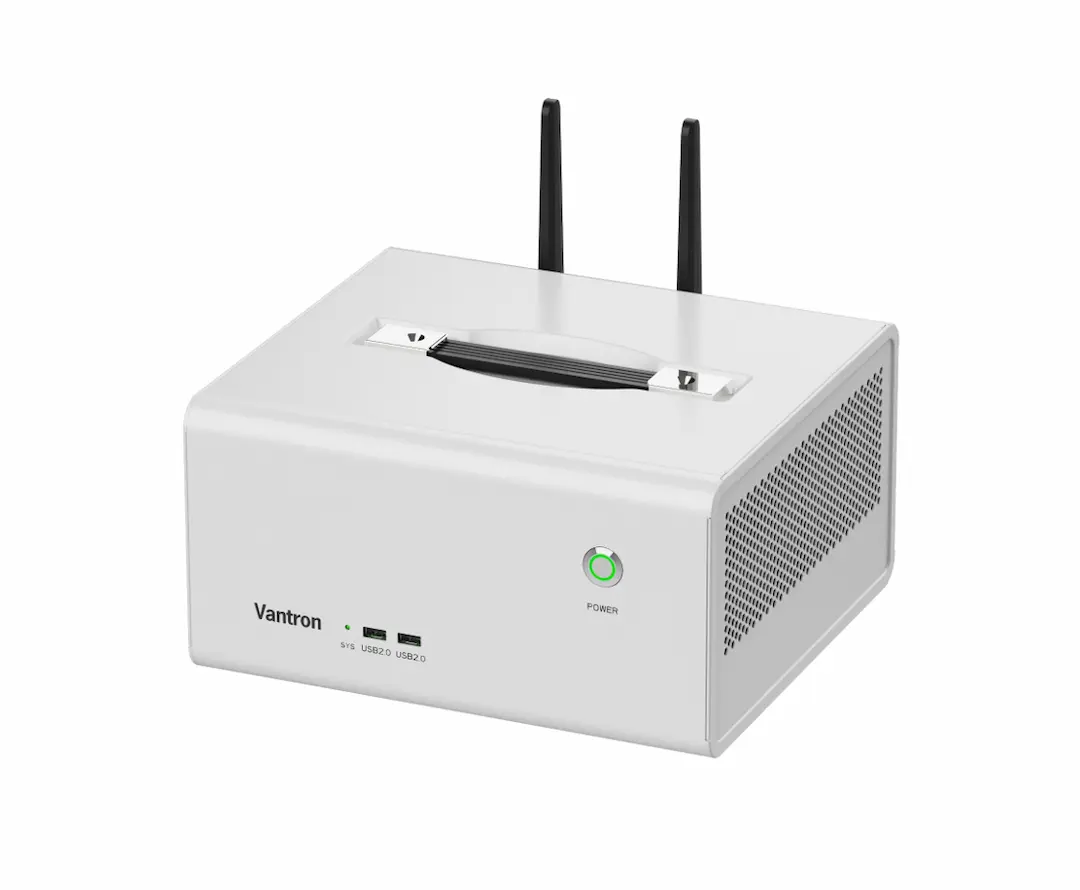
Designed for medical AI applications, Vantron’s healthcare computing portfolio includes the EPC-H610-H Expandable Medical AI Box PC. This robust system accommodates Intel 12th through 14th Gen Core processors, offers PCIe expansion for extra AI acceleration hardware, and adheres to medical-grade design requirements.
The Hardware Layer Determines How AI Enters Medical Workflows
AI algorithms only become valuable when they can operate within practical healthcare workflows. Hardware limitations can prevent advanced models from being effectively deployed.
Medical computing platforms must support communication with different medical peripherals, displays, storage systems, and network environments.
A computer healthcare solution designed for AI applications often requires more than basic computing performance. It needs expansion capability, stable operation, and compatibility with clinical equipment.
For example, AI-assisted imaging systems may require additional acceleration resources to handle inference workloads. Medical monitoring solutions may require multiple connections to collect and analyze information from different devices.
The hardware platform becomes the foundation that determines whether AI technology can move from a demonstration model into daily clinical operations.
Medical environments also require attention to safety and reliability. Vantron’s EPC-H610-H medical AI box PC is designed with healthcare applications in mind and supports IEC 60601-related medical product design considerations.
Medical AI Box PCs Connect Algorithms with Real Healthcare Applications
The practical value of healthcare AI becomes clearer when algorithms are integrated into specific clinical workflows. Different applications place different demands on computing hardware, from high-performance image analysis to continuous real-time monitoring and workflow automation. Medical computing platforms therefore need to provide sufficient processing capability, connectivity, and reliability for the intended clinical scenario.
AI-Assisted Medical Imaging
Medical imaging is one of the most established applications of healthcare AI. AI models can assist with the processing and analysis of ultrasound, CT, X-ray, and other medical images by identifying patterns, highlighting areas of interest, or supporting image-based assessment. These workloads can involve large image datasets and computationally intensive inference, making local computing resources valuable for reducing processing delays and supporting responsive imaging workflows.
A Medical Box PC equipped with suitable CPU, GPU, or AI acceleration resources can provide the computing foundation for integrating AI-assisted analysis directly into imaging equipment or diagnostic workstations. This allows healthcare equipment developers to match computing resources with the requirements of specific imaging applications.
AI-Based Patient Monitoring
AI can also support continuous patient monitoring by analyzing data collected from medical sensors and connected monitoring devices. Instead of simply displaying individual measurements, AI-enabled systems can process multiple data streams to identify changes, detect abnormal patterns, and generate timely alerts for healthcare professionals.
These applications require computing platforms capable of handling data continuously and reliably. Local edge processing can reduce dependence on remote servers and help monitoring systems respond to incoming data with lower latency, particularly when rapid analysis is important to the workflow.
Clinical Decision Support
Another important application is clinical decision support. AI models can process patient data, medical images, test results, and other information to provide insights that may assist healthcare professionals in evaluating clinical conditions or identifying relevant patterns.
In this scenario, the role of AI is not simply to generate an output but to integrate computational analysis into an existing clinical decision-making process. The underlying computing platform must therefore support reliable data processing, appropriate connectivity, and compatibility with the surrounding medical equipment and software environment.
AI-Driven Workflow Optimization
Healthcare AI can also improve operational workflows beyond direct diagnosis and monitoring. AI-enabled systems can assist with tasks such as medical image triage, information processing, equipment management, and other repetitive processes. By automating selected computational tasks, healthcare organizations can reduce manual workload and allow professionals to focus on higher-value activities.
These applications may require different combinations of processing performance, storage, networking, and peripheral connectivity. A flexible Medical Box PC can provide a common hardware foundation while allowing developers to configure computing resources according to the requirements of each healthcare workflow.
Building Reliable AI Infrastructure for Future Healthcare Systems
The evolution from algorithms to clinical applications represents a complete technology chain. AI models provide the intelligence behind medical imaging, patient monitoring, clinical decision support, and workflow optimization, while computing infrastructure enables these capabilities to operate with real medical data and equipment.
