A single full-screen source does not always need another processing stage. If a display system already accepts the required signal, maps it correctly, and recalls the only layout the site uses, an added chassis may create cost and extra failure points without changing the picture.
The need for an LED video wall processor appears when composition, routing, synchronization, or operational recovery must occur before content reaches the displays. The decision is less about screen size than about how often the canvas changes. A large wall with one fixed input can be simple; a smaller command wall with many live windows can demand extensive real-time control.
Identify What the Display System Already Does
The first inventory belongs at the downstream end. Some LED control systems can scale one source, divide it across cabinets, and store a basic configuration. In that case, an LED video wall processor is unnecessary if the source format remains stable, no independent windows are required, and operators do not need live preview or frequent routing changes.
The display-side assessment should include native input count, scaling rules, saved layouts, timing behavior, and recovery after signal loss. A feature that exists only in a service menu may not satisfy an operating requirement that venue staff must use repeatedly during normal events.
This conclusion depends on verified functions rather than assumptions about an internal controller. The project should document accepted input formats, maximum raster, scaling behavior, preset capability, recovery after power loss, and whether the display can preserve aspect ratio on its native canvas. The division of content responsibility can also change the required architecture.
If the upstream player always renders the final native canvas, the downstream stage may only need deterministic distribution. If the site expects local operators to rearrange sources, the display layer must expose usable composition controls rather than a commissioning-only map that cannot be changed safely during operation.
Locate the Point Where Composition Becomes Necessary
Multiple source windows change the problem. A control room may combine dashboards, cameras, maps, and conferencing feeds; a venue may move a presentation beside a live image and then return to a full-canvas program. An LED video wall processor becomes justified when these sources must be cropped, layered, resized, roamed, or switched without rebuilding the LED mapping each time.
Irregular and ultra-wide canvases strengthen the case because standard 16:9 source behavior rarely matches the final raster. Real-time preview lets an operator confirm the composed scene before it reaches the audience, while a large preset library turns repeatable layouts into controlled states rather than manual window adjustments.
Account for Routing, Timing, and Redundancy
Layout is only one layer of the decision. Sites with many rooms or walls may need any input routed to several destinations, independent output groups, backup paths, or a common timing reference. The LED video wall processor then acts as the coordination point for signal ownership.
EDID management stabilizes source recognition, Genlock can align the processing path with cameras or broadcast equipment, and monitoring exposes faults that an individual display may not report. These functions matter most when an error affects more than one screen. A saved scene and a known backup route can restore the operating state faster than separate local adjustments at every endpoint.
Latency requirements should be written beside the routing needs. A status board assembled from delayed data may tolerate more processing than an image-magnification system tied to a live camera. The processing boundary has to satisfy the most time-sensitive source, not the average source in the room.
Choose Between Standard Video Outputs and Direct LED Control
Two architectures can satisfy complex composition. A processor may create the finished layouts and send standard video signals to separate LED controllers, or it may integrate the control stage.
The LED video wall processor should match the intended boundary: conventional outputs favor an established downstream control layer, while integrated Ethernet or fiber paths can reduce devices when the same platform is meant to own the wall. The SEn family from Kystar emphasizes professional processing and output routing, with a broad mixture of DP, HDMI, DVI, SDI, IP, and HDBaseT inputs and up to 32 4K@60Hz outputs.
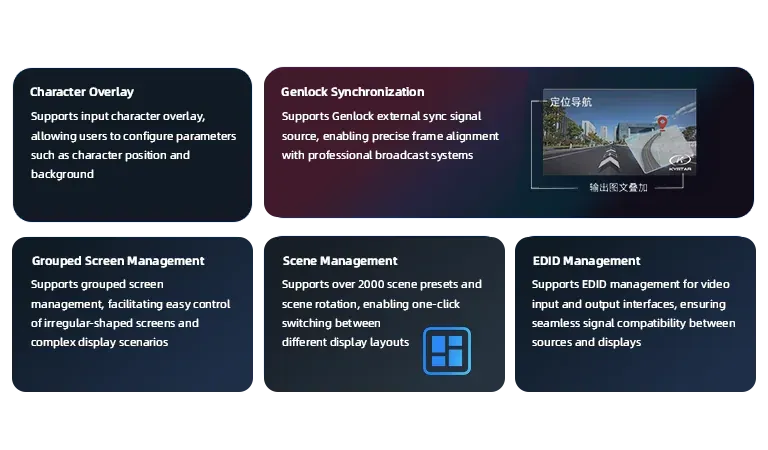
SHn combines switching, splicing, and LED display control in a modular FPGA platform, supporting 8K workflows, flexible windowing, browser control, preview, monitoring, backups, EDID management, Genlock, more than 2,000 scene presets, and large LED loads.
Let Operational Evidence Set the Boundary
A practical trial settles the question more reliably than a feature comparison. The heaviest intended layout should run with real sources, expected switching, preview, and a simulated interruption. If the displays reproduce that workflow directly and recovery remains clear, a separate LED video wall processor adds little.
If windows, routes, synchronized scenes, or redundancy cannot be managed as one system, the missing processing layer has been identified. The appropriate answer may differ across sites in the same organization.
A fixed information wall can remain simple, while a nearby operations wall warrants centralized composition. The deciding fact is not whether a processor is available, but whether the display layer can perform and recover the approved layout without relying on improvised upstream tools.
A decision record can remain short: required scenes, source changes, preview method, failure response, and the device responsible for each function. That document prevents later content requests from silently transferring composition duties to a stage that was never sized or operated for them.
