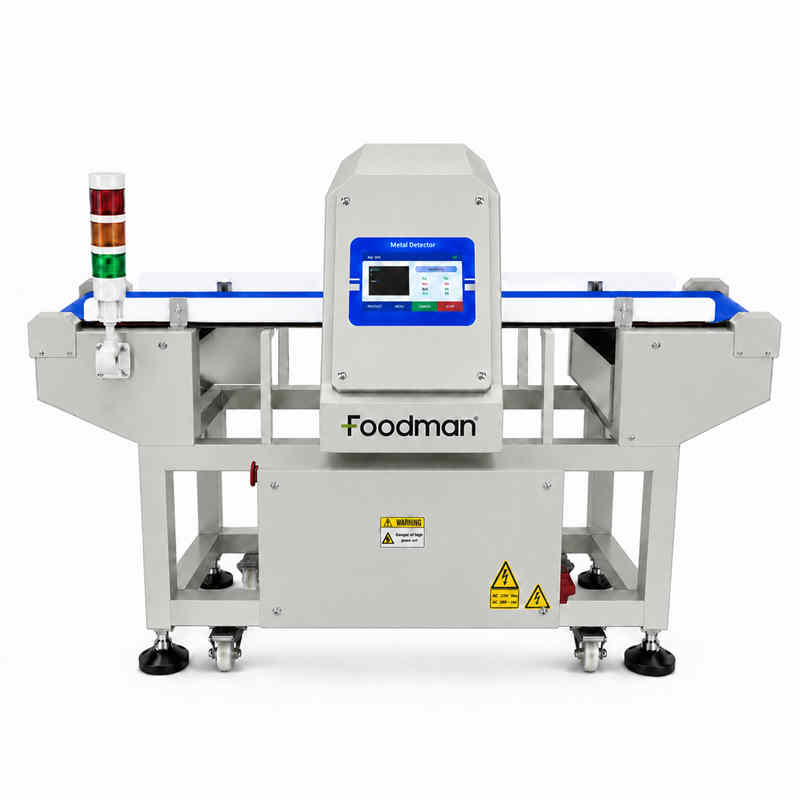
Food‑processing facilities face persistent risks from hidden non‑metallic contaminants that conventional metal detectors cannot catch. Understanding how a food X‑ray machine identifies these hidden debris helps quality teams select and operate inspection equipment for stable food‑safety compliance. Understanding how a food X-ray machine isolates hidden debris involves examining high-energy physics, density differentials, and digital signal processing.
Generation and Emission of Controlled X-Ray Beams
Inside the X‑ray unit, specialized vacuum tubes produce ionizing radiation pointing toward the inspection window. High‑voltage current speeds up electrons hitting a heavy tungsten target within the shielded housing. As electrons slow rapidly, their kinetic energy converts into invisible high‑frequency electromagnetic radiation.
Collimators shape the emitted radiation into a narrow, highly focused fan beam spanning the entire conveyor width. Precise power regulation ensures stable photon output throughout prolonged industrial production shifts.
Uninterrupted radiation consistency prevents baseline signal distortions during high-speed manufacturing runs. Equipment designers optimize source positioning to maximize radiation coverage uniformly.
Product Penetration and Differential Density Attenuation
Packed or loose food items cross the inspection zone on low-absorption conveyor belts. Photons collide with organic matrices, moisture pockets, and any hidden foreign objects embedded inside.
Dense materials absorb significantly more radiation than surrounding food tissue due to atomic weight variations. Molecular density dictates the exact absorption rate of passing electromagnetic waves.
Metallic fragments, dense glass shards, and calcified bones attenuate the beam far more aggressively than organic matter. Lower-density items allow a high volume of photons to pass through completely unhindered.
Measuring this differential transmission rate forms the foundational physics of modern radiographic screening. Advanced algorithms interpret these absorption gradients to isolate foreign bodies.
High-Resolution Sensor Arrays and Photon Conversion
Emerging photons strike a linear photodiode array positioned directly beneath the moving conveyor belt. Scintillator crystals convert invisible X-ray energy into visible light pulses instantly upon impact.
Subsequent photodiodes transform those light flashes into proportional electrical current signals. Sensitive semiconductor components capture even minor radiation fluctuations with extreme fidelity.
Microscopic pixel spacing guarantees high spatial resolution across every scanned product profile. Electronic circuits sample analog voltage outputs at microsecond intervals to maintain extreme dimensional accuracy.
Engineering teams at Foodman calibrate these sensor rows to detect minute contaminant particles reliably. Robust shielding protects internal electronics from stray radiation leakage.
Digital Image Reconstruction and Gray-Scale Mapping
Analog voltage signals flow continuously into high-speed digital signal processors for immediate conversion. Software algorithms translate raw photon attenuation values into detailed grayscale radiographic images.
Darker pixels indicate dense foreign objects, whereas lighter areas represent standard food composition. Computers process millions of pixels per second during peak operations.
Complex product shapes create natural thickness variations that complicate raw image interpretation. Advanced software normalizes background product contours to prevent false positives caused by overlapping items.
Technicians utilize calibration tools provided by Foodman Vision to fine-tune grayscale sensitivity thresholds. Digital mapping converts raw data into intuitive visual displays.
Algorithmic Contrast Enhancement and Defect Isolation
Digital filters isolate foreign anomalies from complex product textures by applying advanced mathematical matrices. Edge-detection algorithms outline sharp boundaries around dense objects hidden deep inside packaged goods.
High-performance computing hardware executes these intensive calculations without creating operational bottlenecks. Sophisticated software architectures analyze pixel contrast ratios continuously.
Overlapping food items frequently generate confusing shadow gradients on standard radiographic displays. Sophisticated neural networks differentiate between harmless product folds and dangerous metallic or mineral contaminants.
Systems operating a food X-ray machine analyze multi-energy absorption ratios to confirm material density. Automated filters discard irrelevant visual noise instantly.
Real-Time Contaminant Flagging and Rejection Logic
Identified contaminants instantly trigger digital warning flags within the central processing architecture. Software coordinates exact rejection timings based on belt speed and distance to downstream actuators.
High-speed pneumatic blowers or mechanical sweeps divert contaminated packages away from clean streams. Precision timing prevents collateral product loss during ejection.
Reliable rejection mechanisms prevent non-compliant products from reaching commercial distribution channels and retail shelves. Facilities integrating specialized solutions from Foodman achieve superior foreign object removal rates consistently. Automated audit logs record every rejection event for comprehensive food safety traceability. Quality control supervisors review these logs daily.
Advanced Calibration and Operational Integrity
Thermal fluctuations inside factory environments can alter X-ray tube output characteristics over extended hours. Automated calibration routines adjust beam intensity and detector gain values during scheduled production lulls.
Regular self-testing ensures every food X-ray machine maintains absolute inspection precision indefinitely. Diagnostic software alerts operators immediately regarding anomalies.
Maintenance technicians monitor diagnostic dashboards to track tube health and system performance metrics. Comprehensive software suites developed by Foodman Vision provide deep insights into long-term operational stability.
Equipment reliability protects capital investments while safeguarding strict industry regulatory compliance. Routine inspections guarantee sustained hardware longevity.
Future Innovations in Radiographic Inspection
Continuous software upgrades expand detection capabilities to identify increasingly subtle contaminants like low-density plastics. Collaborative engineering partnerships yield enhanced scanning speeds and superior image resolution capabilities.
Foodman remains dedicated to advancing inspection technologies for modern industrial processing plants. Industry partnerships foster rapid technological breakthroughs.
Pioneering inspection methodologies developed alongside Foodman Vision redefine quality control standards across global manufacturing sectors. Strategic equipment investments guarantee long-term operational excellence and complete consumer safety protection.
Industrial processing leaders rely on advanced radiography to secure competitive market advantages. Global supply chains demand uncompromised product purity.
Third-generation detection platforms incorporate artificial intelligence to streamline complex multi-product calibration routines automatically. Operator training programs ensure internal teams maximize inspection efficiency without halting primary production workflows.
Modern facilities utilizing advanced radiographic systems achieve uncompromised product integrity across every operational shift. Advanced software ecosystems drive future automation.
