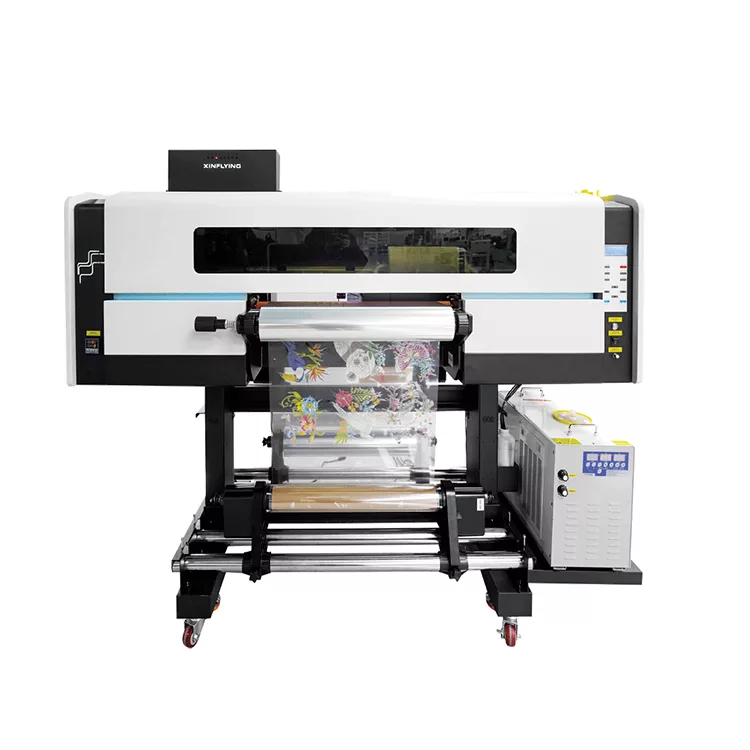
As demand for customized products grows, printing businesses must balance production volume, consistent quality, and operating costs. Small-scale equipment may suit occasional orders, but expanding into wholesale transfers, promotional merchandise, and personalized product decoration requires a more structured production approach. Investing in a suitable commercial UV DTF printer can help businesses increase capacity while maintaining flexibility across different designs and customer requirements.
Why Industrial Printing Capacity Matters
For printing companies, scaling up involves more than purchasing a faster machine. Production teams must coordinate artwork preparation, printing, film handling, quality inspection, and order fulfillment. A bottleneck at any stage can delay deliveries, increase waste, and reduce profitability.
UV DTF printing offers a practical option for decorating compatible hard surfaces. Designs are printed onto specialized film and prepared for transfer, allowing businesses to produce graphics for products such as glassware, acrylic items, metal accessories, and selected plastic surfaces. Substrate compatibility and surface preparation should be tested before commercial orders are accepted. [Source: Roland DG](https://www.rolanddga.com/en/blog/how-to-print-uv-dtf-and-uv-htv)
For growing operations, the objective is to establish repeatable production rather than simply maximize machine speed. Consistent print quality, manageable job changes, and reliable equipment operation all contribute to sustainable output.
What to Evaluate in a Commercial UV DTF Printer
Printhead Configuration and Output Consistency
Printhead configuration affects how a machine deposits ink and handles detailed artwork. Businesses should evaluate the printhead model, nozzle performance, supported ink configuration, and practical production speed when comparing equipment.
A suitable UV DTF printer manufacturer should provide clear technical specifications and help buyers understand how rated performance translates into their actual workload. Production estimates should account for artwork complexity, print settings, media handling, maintenance, and finishing time rather than relying exclusively on advertised maximum speeds.
Mechanical Stability for Continuous Production
Heavy-duty guide rails and a stable carriage structure help maintain controlled printhead movement. This matters when equipment operates regularly and must reproduce fine details across multiple jobs.
A stable motion system can support consistent alignment and reduce quality variations associated with mechanical movement. However, equipment performance also depends on installation, routine maintenance, appropriate operating conditions, and correct media handling.
Intelligent Controls and Workflow Efficiency
Temperature and power management can help operators maintain controlled operating conditions. For commercial teams, accessible controls and a clearly defined operating procedure also make production easier to monitor and standardize.
Automation should be assessed in relation to the entire workflow. Features such as integrated lamination, automatic film handling, and monitoring systems can reduce manual intervention when included in the machine configuration. Buyers should confirm which functions are standard and which require optional equipment.
How Xinflying Supports Higher-Volume Printing
Xinflying supplies digital printing equipment and integrated printing solutions for businesses seeking to expand their production capabilities. Its XF-600S 3D UV DTF Printer combines UV DTF printing with simulated embroidery effects, creating raised decorative textures without traditional stitching.
The XF-600S features three Epson i3200-U1 printheads and a 24-inch printing width. Its listed production speed is 3 m² per hour at six-pass printing. These specifications provide buyers with a concrete starting point for evaluating whether the machine fits their order volume and quality requirements.
The machine also incorporates a heavy-duty guide rail system designed to support stable carriage movement and printing accuracy. An intelligent temperature and power control system is intended to improve operating efficiency and reliability in commercial environments.
For businesses serving customers who value distinctive product finishes, the simulated embroidery effect offers an additional decoration option. It may help expand product offerings beyond conventional flat graphics, subject to suitable artwork preparation and production testing.
Building a More Efficient Production Workflow
Standardize Artwork and Job Preparation
Before printing, operators should check artwork dimensions, resolution, color requirements, and layout. Grouping compatible jobs can improve film utilization and reduce unnecessary setup changes. Reusable templates are particularly helpful for repeat orders and wholesale production.
Control Printing and Film Handling
A defined procedure for media loading, print settings, curing, and lamination helps reduce avoidable inconsistencies. Operators should follow the equipment and consumables suppliers’ instructions, checking the first output before proceeding with a large batch.
A commercial UV DTF printer should be assessed by its usable output under actual operating conditions, not just its rated speed. Recording production time, rejected transfers, material consumption, and maintenance interruptions helps managers identify recurring bottlenecks.
Introduce Quality Checks Before Dispatch
Inspection should cover color appearance, fine details, transfer alignment, lamination quality, and application performance on the intended substrate. Testing representative samples before mass production helps identify problems early.
Businesses should also document customer-approved samples and application instructions. This creates a consistent reference for repeat orders and helps production staff resolve quality concerns more systematically.
Calculate Capacity Before Expanding
Equipment investment should match both current demand and realistic growth forecasts. Buyers can estimate required production hours by comparing expected monthly demand with verified output under their chosen print settings. Additional time must be reserved for setup, maintenance, finishing, and quality control.
When comparing suppliers, businesses should review machine specifications, consumable costs, training, technical support, spare-part availability, and warranty terms. A reliable UV DTF printer manufacturer should help buyers assess these factors alongside the purchase price.
It is also important to confirm the intended application before choosing a machine. UV DTF transfers are designed primarily for compatible hard surfaces, whereas conventional DTF systems serve fabric-decoration workflows. Selecting the appropriate technology prevents unnecessary investment and mismatched customer expectations.
Scaling Production with the Right Equipment
Expanding industrial printing output requires coordinated decisions about equipment, workflow, quality assurance, and operating costs. A well-matched commercial UV DTF printer can help printing businesses handle larger workloads while offering more decorative possibilities to their customers.
With its XF-600S integrated printing solution, Xinflying provides an option for companies evaluating wider-format production and simulated embroidery effects. By verifying specifications, testing representative jobs, and planning capacity around actual demand, buyers can make informed investment decisions and build a more dependable printing operation.
