Orthodontic treatment is no longer focused only on tooth alignment. Modern orthodontists increasingly consider facial appearance, smile aesthetics, and the relationship between teeth and facial structures when creating treatment plans. Digital technologies are helping professionals visualize potential outcomes before treatment begins. A smile simulator combined with a 3D face scanner can provide valuable insights for orthodontic planning, improving communication between dentists and patients while supporting more personalized treatment strategies.
Why Orthodontic Planning Needs More Than Traditional Dental Records?
Traditional orthodontic planning mainly relies on clinical examinations, photographs, X-rays, and dental models. These methods provide important information about tooth position and jaw structure, but they may not fully represent how treatment changes will affect the patient’s facial appearance.
A patient’s smile involves multiple elements, including:
- Tooth alignment and shape.
- Lip position and movement.
- Facial symmetry.
- Smile line and overall facial balance.
Because orthodontic treatment can influence both function and aesthetics, professionals increasingly use digital tools to evaluate the relationship between dental changes and facial appearance. A digital approach allows orthodontists to create a more comprehensive treatment plan by combining different types of patient data into one virtual environment.
How a Smile Simulator Supports Orthodontic Treatment Planning?
A smile simulator allows dental professionals and patients to visualize possible orthodontic outcomes before treatment starts. Instead of explaining expected changes only through words or static images, clinicians can provide a clearer visual representation of potential results.
During orthodontic consultations, a smile simulator can help demonstrate:
- Possible improvements in tooth alignment.
- Changes in smile appearance after treatment.
- The relationship between teeth and facial aesthetics.
- Different treatment possibilities for discussion.
This visualization can improve patient understanding and help orthodontists communicate realistic expectations. However, simulation results are designed as a planning reference rather than a guaranteed final result because actual outcomes depend on biological response, treatment progress, and clinical execution.
The Importance of a 3D Face Scanner in Orthodontic Simulation
A 3D face scanner plays an important role in improving the realism of digital orthodontic planning. Traditional photographs capture only two-dimensional facial information, which limits the ability to analyze depth, contours, and spatial relationships.
A professional 3D face scanner captures detailed facial geometry and creates a three-dimensional representation of the patient. When combined with intraoral scans, this data allows orthodontists to evaluate dental changes within the context of the entire face.
Important information captured through facial scanning includes:
- Facial proportions and symmetry.
- Lip position during smiling.
- Relationship between teeth and facial structures.
- Three-dimensional aesthetic changes.
This facially driven approach helps orthodontists move beyond tooth-focused planning and consider how treatment may influence overall appearance.
SHINING 3D Dental MetiSmile Helps Create Digital Orthodontic Simulations
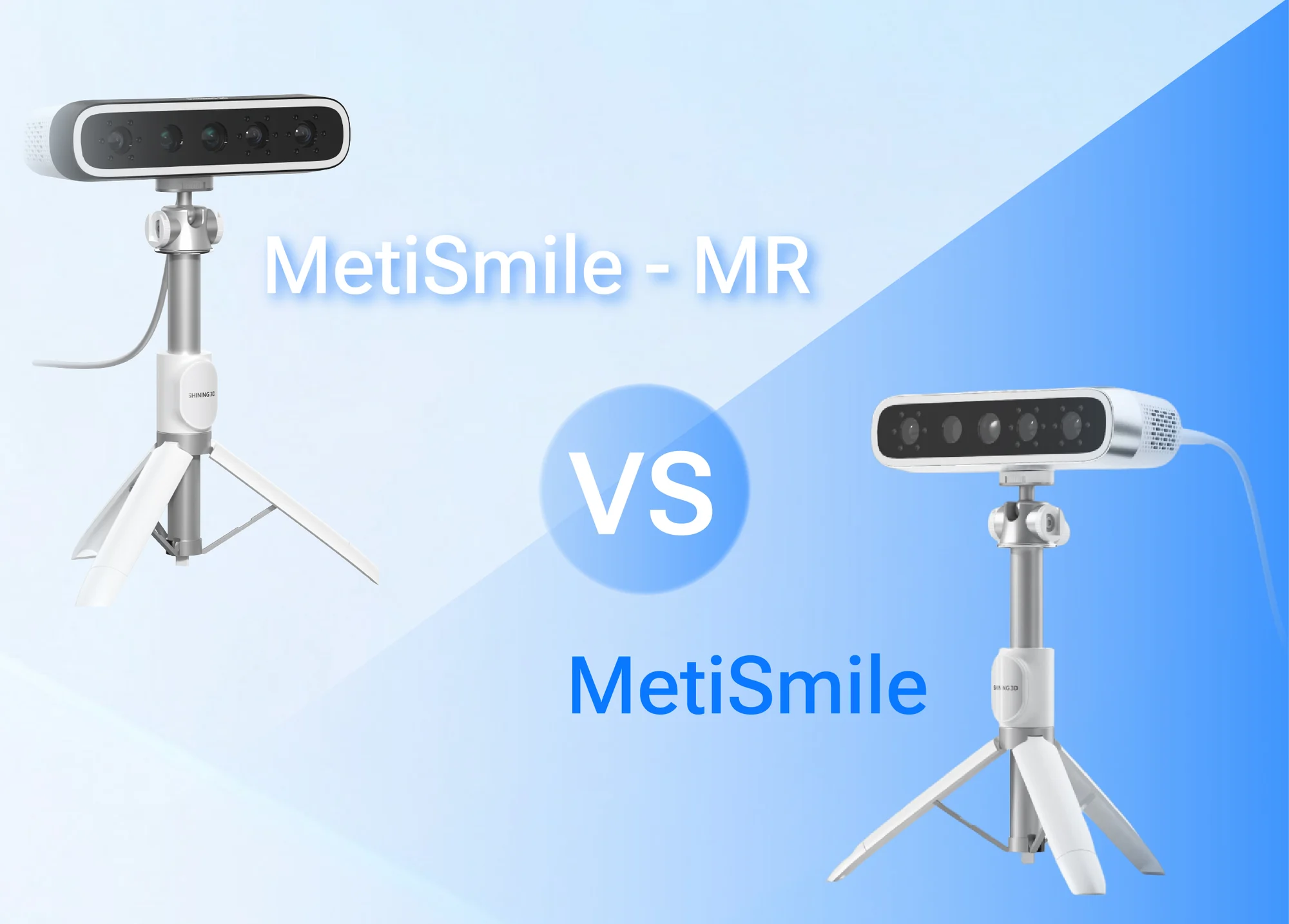
SHINING 3D Dental provides digital dentistry solutions designed to support modern clinical workflows. Its MetiSmile facial scanning solution combines a high-precision 3D face scanner with intelligent smile simulation technology to help dental professionals visualize facial aesthetics and orthodontic changes before treatment.
MetiSmile supports orthodontic facial simulation by allowing clinicians to simulate potential changes in both teeth and facial appearance. The system can integrate facial data with intraoral scan information, creating a more complete virtual patient model for treatment communication and planning.
According to the official specifications, MetiSmile includes a 1.3-megapixel data acquisition camera and a 5.0-megapixel HD texture camera. It provides 50μm accuracy, supports PLY, OBJ, and STL output formats, and has a field of view of 210 × 270 mm at a 500 mm working distance. These specifications help dental professionals capture detailed facial information for digital workflows.
How Facial Simulation Improves Patient Communication?
Orthodontic treatment often requires long-term commitment, and patients want to understand how their smile may change. Digital simulation provides a visual tool that can make treatment discussions more effective.
When patients can view a possible outcome, they may better understand:
- Why a specific orthodontic approach is recommended.
- How tooth movement may influence smile aesthetics.
- The relationship between orthodontic goals and facial appearance.
For orthodontists, this technology creates a more interactive consultation process. Instead of relying only on technical explanations, professionals can use digital models to explain treatment concepts more clearly.
Can Smile Simulation Predict Exact Orthodontic Results?
Although smile simulation technology has advanced significantly, it cannot predict every detail of the final orthodontic outcome. Human biology is complex, and factors such as bone structure, tooth movement response, soft tissue adaptation, and patient cooperation can influence results.
A smile simulator should therefore be viewed as a communication and planning tool. It helps orthodontists evaluate aesthetic possibilities, but professional diagnosis and treatment monitoring remain essential.
The accuracy of simulation depends on several factors:
- Quality of facial and dental data collection.
- Accuracy of digital models.
- Experience of the orthodontic team.
- Complexity of the treatment case.
When these elements are combined effectively, digital simulation can become a valuable part of orthodontic decision-making.
Combining Digital Data for More Complete Orthodontic Workflows
Modern orthodontics increasingly relies on connected digital systems. A 3D face scanner, intraoral scanner, imaging technology, and treatment planning software can work together to create a comprehensive digital patient model.
SHINING 3D Dental’s MetiSmile supports this integrated approach by enabling facial data collection, aesthetic analysis, and orthodontic simulation within a digital workflow. The system also supports compatibility with digital dental software platforms, helping professionals incorporate facial information into broader treatment planning processes.
This type of workflow allows orthodontists to evaluate treatment from both functional and aesthetic perspectives, creating more patient-centered solutions.
The Future of Digital Orthodontic Planning
As digital dentistry continues to develop, technologies such as facial scanning and simulation will become increasingly important in orthodontic workflows. Patients are seeking treatments that improve not only dental function but also confidence and appearance. A smile simulator supported by accurate facial data can help orthodontists provide clearer treatment explanations, improve communication, and create more personalized plans.
Conclusion
A smile simulator can support orthodontic planning by providing a visual preview of potential treatment outcomes and helping professionals evaluate the relationship between teeth and facial aesthetics. When combined with a 3D face scanner, digital simulation offers a more complete view of how orthodontic changes may affect the patient’s smile and appearance.
With solutions such as SHINING 3D Dental‘s MetiSmile, orthodontic professionals can integrate facial scanning, simulation, and digital treatment planning into modern workflows. While simulation does not replace clinical expertise, it provides an effective tool for improving consultation quality and creating more informed orthodontic treatment decisions.
