Motor specifications can look impressive on a sales sheet, yet numbers alone rarely explain how an electric scooter will behave on everyday roads. Dealers need to understand what power ratings, heat management, acceleration, and operating conditions mean for real customers, without getting lost in engineering terminology.
For businesses comparing E scooter suppliers, the ability to explain these factors clearly can improve purchasing decisions and customer confidence. LUYUAN, an electric mobility manufacturer with experience in liquid-cooled motor technology, operates in a market where practical performance and technical credibility both matter.
Translate Motor Specifications Into Everyday Performance
Rated power describes the motor’s designed continuous output under specified conditions, while peak power refers to a higher output that may be available only for a limited period. These figures serve different purposes and should not be compared as though they represent the same operating condition. A scooter with a higher peak rating may feel responsive during acceleration, but its everyday performance also depends on vehicle weight, controller settings, battery output, and the rider’s load.
Torque is another useful concept, particularly for customers who travel on slopes or frequently start from a standstill. In simple terms, torque describes rotational force, while power relates to the rate at which work is performed. Neither figure tells the whole story independently. Gear ratios, wheel size, controller programming, and traction can influence how effectively the available motor output reaches the road.
Sales teams can make technical comparisons more meaningful by connecting each specification to a customer’s intended use. A commuter who travels through stop-start traffic may value smooth acceleration and predictable response, whereas a rider facing sustained inclines may care more about climbing behaviour under load. A knowledgeable liquid cooled motor supplier should be able to explain the operating conditions behind its published figures and clarify which comparisons are technically valid.
Explain Heat Management Without Overcomplicating It
Heat is a natural by-product of electrical and mechanical operation. During demanding use, some energy is lost as heat in the motor and associated components. If temperatures rise beyond the system’s intended operating range, protective controls may reduce output to manage thermal stress. Riders can experience this as a change in available performance, especially during extended climbs, heavy loading, or repeated high-power operation.
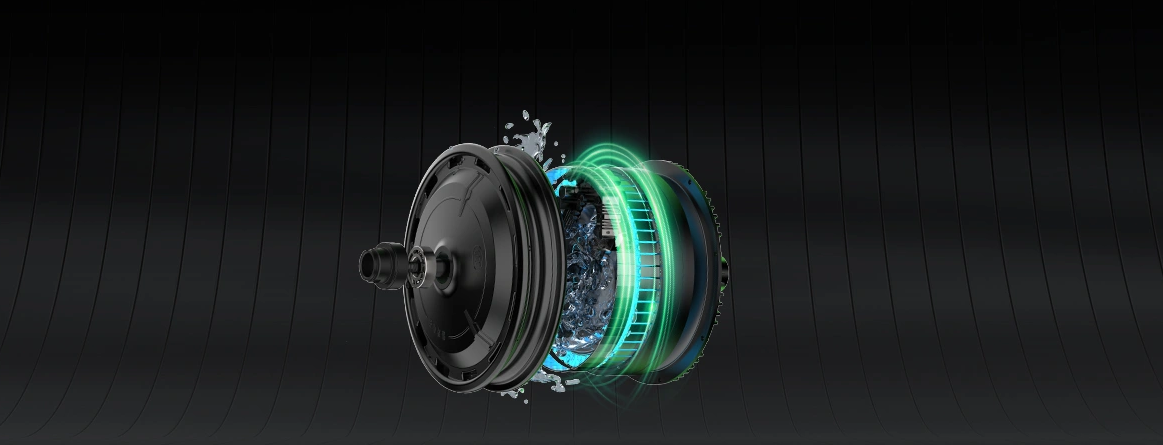
Cooling systems help manage that heat, but different designs use different methods. Air-cooled motors typically rely on heat transfer to surrounding air, while liquid-cooled systems circulate coolant through a designed pathway to carry heat away from critical areas. The actual result depends on the complete system, including coolant circulation, heat-exchange capacity, component design, and operating conditions. Liquid cooling should not automatically be interpreted as higher efficiency or greater durability in every application.
LUYUAN identifies liquid-cooled motor technology as one of its technical strengths and highlights its development experience in this field. When discussing a liquid cooled motor, buyers should ask which components are cooled, how temperature is managed during demanding operation, and what maintenance the system requires. Questions about thermal protection, inspection intervals, coolant servicing where applicable, and warranty coverage can reveal more about practical ownership than a broad claim about cooling technology alone.
Evaluate Motor Performance Under Real Operating Conditions
A specification sheet provides a starting point, but controlled testing offers a clearer view of how a vehicle performs. Relevant checks may include acceleration, hill climbing, thermal behaviour, braking, and energy consumption under a defined load. Comparisons are meaningful only when test conditions are reasonably consistent: differences in rider weight, ambient temperature, road gradient, battery charge, and speed can produce noticeably different results.
Range claims deserve particular care. Motor output is only one factor affecting energy use; battery capacity, riding speed, terrain, tyre pressure, wind resistance, and stop-start frequency also influence distance travelled. Buyers should check whether a published range comes from a laboratory procedure, a controlled test, or typical road use. Retailers can then describe the result with appropriate context rather than treating it as a fixed distance every customer will achieve.
For distributors, the technical review should extend beyond the motor itself. Battery discharge capability, controller limits, wiring, protection systems, and the vehicle’s mechanical design all contribute to the final riding experience. E scooter suppliers that can provide clear documentation and explain the relationship between these components make it easier for dealers to compare products fairly. A coherent system matters more than one standout number on a specification sheet.
Conclusion
Motor performance becomes easier to evaluate once technical figures are connected to practical riding conditions. Power and torque describe different aspects of output, thermal management affects sustained operation, and real-world range depends on a combination of vehicle and environmental factors.
Buyers who understand these distinctions can ask more precise questions and avoid relying on headline specifications alone. With its experience in electric mobility and liquid-cooled motor technology, LUYUAN is one option for distributors assessing technical capabilities and supplier support, while informed comparison remains essential to a sound long-term partnership.
